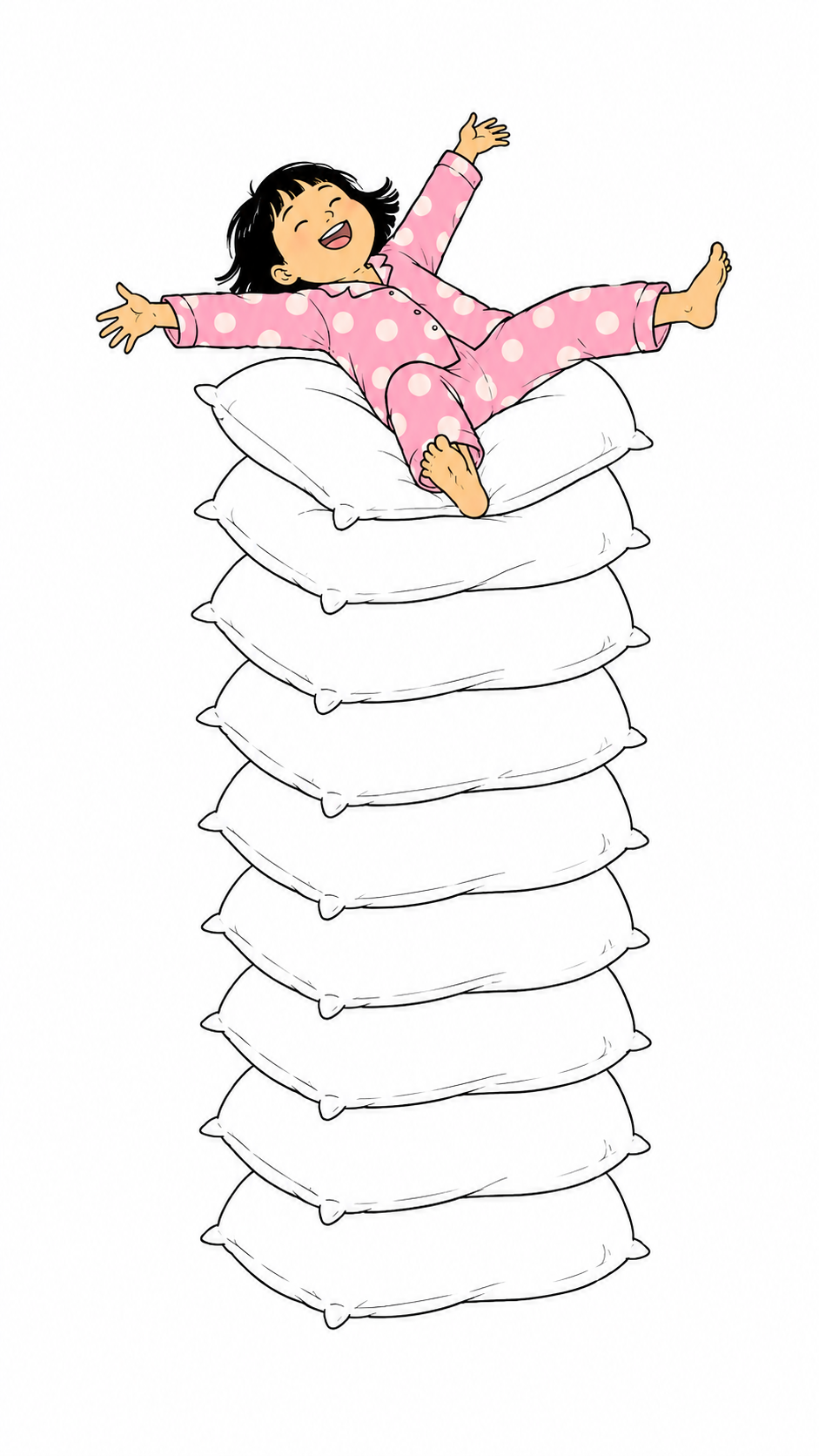
Ten Big, Soft, Fluffy Pillows
Why voter sovereignty is less scary than it looks
For a lot of people, the first encounter with voter sovereignty feels less like a civics lesson and more like being gently escorted toward the edge of a cliff.
“Wait—the voters actually get the final vote? Without first passing an exam, completing twelve workshops in respectful dialogue, or proving they can be trusted with sharp objects?” The mind immediately supplies misinformation, mob rule, laziness, corruption, chaos, bad judgment, and probably somebody voting from the bathtub.
Fair enough. Putting the voters in charge is a leap. But there are some remarkably substantial things underneath us. Ten of them, in fact. Big, soft, fluffy pillows. None guarantees that voters will never make a mistake; no political system comes with that warranty. They simply give us good reason to doubt the familiar prediction that if ordinary people get real power, civilization immediately catches fire.
The First Pillow: People Change When Their Agency Changes
We tend to look at a politically disengaged public and conclude that disengagement must be something inherent in the public. But people behave differently when they have autonomy, when they can develop competence, and when what they do actually matters. Straight-Up reverses the usual sequence: civic maturity is not an entrance exam for political power. Give people something real to decide, a human-scale setting in which their participation matters, and a chance to learn through doing. If ignorance is rational because your political influence is negligible, perhaps the answer is not to scold people into caring harder. Change the conditions that made not caring rational.
The Second Pillow: Nobody Has to Know Everything
Millions of voters cannot possibly master every page of every bill. Correct. Neither can members of Congress, and fortunately nobody is proposing 150 million miniature legislative research offices. The important question is not whether every voter can contain the federal government inside their head. It is whether information can move through the system intelligently. Circles, delegates, committees, direct votes, revocable proxies, and Back & Forth communication give voters ways to ask, learn, specialize, delegate, check, and step back in when something matters to them. The problem with the legacy system is not that ordinary people know too little. It is that what they do know has nowhere coherent to go.
The Third Pillow: Mistakes Come With Erasers
Yes, voters will make mistakes. Welcome to the human race. The important design question is what happens next. The legacy system gives voters an extraordinarily crude correction mechanism: wait for the next election and decide whether one politician’s entire bundle of actions deserves a thumbs-up or thumbs-down. Straight-Up builds correction into ordinary political life. Votes can be retrieved, delegates replaced, instructions changed, relationships reorganized, and decisions revisited. That does not mean permanent frenzy; good procedures can provide plenty of friction and stability. The question is not whether democracy will make mistakes. The question is who holds the eraser.
The Fourth Pillow: Millions of People Do Not Have to Become a Mob
Direct voter power sounds chaotic only if we imagine millions of people dumped into one gigantic room and told to work it out. We have absolutely no intention of doing that. The Straight-Up System is recursive and human-scaled: people organize in Circles, Circles connect through Links, committees specialize, delegates carry information and voting weight, and the system scales in layers. There is an important distinction here: hierarchy can describe how work and information are organized without describing who owns the power. Straight-Up uses layers for organization while keeping legislative authority with the voters. A mob is lots of people without enough structure. Straight-Up is lots of people with structure—the structure of freedom.
The Fifth Pillow: Delegates Don’t Get to Run Away With the Vote
The familiar problem with representation is that we hire someone to act for us and then discover that the employee has acquired the office, the information, the institutional position, and—most importantly—the decision-right. Straight-Up keeps the principal in charge. A delegate can carry your voting power because you want them to. You can take it back. A Straight-Up Representative may physically cast a district’s vote in Congress, but the Representative does not own that vote; the voters generated it. That is a substantially tighter leash than, “Please remember what I told you twenty-three months ago when I elected you.”
The Sixth Pillow: Capture Gets a Much Less Convenient Target
Will wealthy interests, organized factions, lobbyists, ambitious operators, and assorted scoundrels try to influence Straight-Up institutions? Of course. We are changing the political system, not the species. But the legacy system gives anyone in the influence business a wonderfully convenient arrangement: a relatively small number of people possess the legal authority to say yes or no. Straight-Up removes that sovereign chokepoint. Influence has to survive changing coalitions, direct votes, revocable delegation, competing information channels, small-group relationships, and the persistent possibility that voters take their votes back. Capture does not become impossible. It becomes much harder to stabilize. Self-government does not eliminate wrongdoing. It means that we are no longer helpless in the face of wrongdoing.
The Seventh Pillow: Maybe Powerlessness Is Doing Some of the Damage
Yes, voters can be angry, cynical, tribal, exhausted, withdrawn, and magnificently irrational. But before diagnosing the patient, it might be worth inspecting the room. People often behave differently when they experience meaningful control than when they repeatedly experience helplessness. We should not pretend that political powerlessness explains every ugly feature of political culture. But neither should we observe people under conditions of very little control and then cite their resulting passivity or anger as proof that they must never be given control. The legacy system produces political powerlessness and then points to the culture of powerlessness as evidence that people should remain powerless. That is at least a hypothesis worth challenging.
The Eighth Pillow: Complexity Does Not Require an All-Knowing Brain
Government is enormously complicated. Luckily, complicated systems do not require every participant—or any single participant—to understand the whole thing. Bodies distribute functions. Cities distribute functions. Organizations distribute functions. A DcL can do the same. Committees can specialize. Delegates can specialize. Experts can advise. AI can analyze. Administrators can administer. Voters do not have to personally perform every task in order to retain ultimate authority over what is done in their name. That is one of Straight-Up’s recurring distinctions: delegate the work; do not permanently delegate the sovereignty.
The Ninth Pillow: Sortition Is Our Friend
Randomly selected citizen assemblies can be enormously useful. Straight-Up does not need to pick a fight with sortition; it simply changes the order of operations. Instead of creating a carefully selected citizen body and then deciding how much authority ordinary voters may safely be allowed, put the voters in charge first. Then let the sovereign public decide where citizen juries, deliberative assemblies, random selection, and sortition of the willing can improve its work. Straight-Up is perfectly happy to use democratic tools. It just wants the toolbox to belong to the voters.
The Tenth Pillow: We Are Allowed to Learn
No one can specify in advance every committee rule, drafting convention, appropriation procedure, oversight mechanism, parliamentary norm, conflict-of-interest policy, and obscure legislative widget that a mature voter-sovereign legislature will eventually need. Thank goodness—we do not have to. The essential architecture can be established while the operating details continue to evolve through practice, expertise, experimentation, criticism, and experience. That is what resources like the Straight-Up Transition Wiki are for. The wiki is not scripture. It is a pantry. DcLs can take what works, reject what does not, improve it, and contribute something better. Critics sometimes demand that we solve every future problem before creating the institution capable of solving future problems. We respectfully decline.
So, About That Cliff...
None of these pillows depends on voters suddenly becoming wise, kind, perfectly informed, or immune to manipulation. People remain people. Straight-Up Democracy does not eliminate bad judgment; it changes who gets to correct it.
The legacy system quietly asks us to accept a rather extraordinary proposition: ordinary people are competent enough to choose the people who will exercise coercive legislative power over them, but not competent enough to retain an equal share of that power themselves. Maybe that proposition is true. But repeating it for two centuries does not make it so.
There is another assumption worth trying: give people real authority, organize that authority intelligently, let them delegate without surrendering, and build correction into the system from the beginning.
We are not promising a system without problems. We are building a system in which the people can solve them.