Proving Democracy
Power, Institutions, and the Search for Self-Government
A Ten-Week Course
Proving Democracy is a ten-week inquiry into democracy, political power, and the institutions through which we govern ourselves. Beginning with something so familiar that it can be difficult to see—our inherited conception of democracy—the course asks which features of contemporary democratic government are actually necessary for self-government and which are simply institutional arrangements we have learned to associate with it. Drawing on political theory, sociology, history, and contemporary democracy reform, we examine competing claims about representation, elections, political parties, deliberation, expertise, and direct citizen participation, continually returning to one deceptively simple question: Who casts the final vote that makes a law?
Week One: Democracy and Common Sense
How inherited political assumptions become invisible; hegemony, common sense, and why representative government feels synonymous with democracy. (See Sample Curriculum)
Week Two: Who Casts the Final Legislative Vote?
The difference between influence, participation, representation, consent, and actual legislative authority—and why choosing who will decide is not the same as retaining the decision.
Week Three: How Does Political Power Travel?
Parties, donors, committees, staff, experts, media, bureaucracy, agenda control, and the channels through which political information, influence, and authority move before a law is made.
Week Four: What Do Democracy Reforms Actually Change?
Campaign finance, ranked-choice voting, proportional representation, anti-gerrymandering, deliberative reforms, sortition, civic education, and other approaches—what each improves, what authority it transfers, and what remains unchanged.
Week Five: What Does Governing Actually Require?
Political labor, expertise, delegation, administration, committees, specialization, and why distributing the work of government does not require transferring sovereignty. (See Sample Curriculum)
Week Six: How Do We Study a Governing System?
Systems thinking, feedback, bottlenecks, requisite variety, network effects, capture, correction, resilience, recursion, and the forces that cause political institutions to reproduce themselves.
Week Seven: Does Democracy Require Better Citizens?
Political competence, civic education, deliberation, trust, polarization, participation, and what decades of research tell us about whether ordinary people are already capable of self-government.
Week Eight: How Could Voters Actually Govern?
The Straight-Up System and Plan: voter sovereignty, Circles, Links, revocable delegation, layered aggregation, Back & Forth communication, committees, the DcL, and its connection to an elected House Representative.
Week Nine: How Do We Keep It a Democracy?
Rights, constitutionalism, minority protection, accessibility, security, accountability, concentrated power, platform control, error correction, anti-capture mechanisms, and the continuing ability of voters to repair their own institution.
Week Ten: How Would We Know?
What would count as evidence that a democratic system works—and what would count as evidence that it does not? Straight-Up is subjected to the same scrutiny as every other model: predictions, failure criteria, comparison, real-world testing, and revision. (See Sample Curriculum)
Each class will have 20-30 pages of required reading. Each lesson will be a two-hour, online session. This is not a lecture format. Classes will be highly interactive, break frequently into work groups, and conclusions will be arrived at collaboratively.
For tuition information and scheduling, contact DemocracyStraightUp@gmail.com, ATTN: Course.

Tuition
$250 — Suggested tuition
$100 — Reduced tuition
$500 — Supporter tuition
$0 — NOTAFLOF
Course starts when we reach ten students.

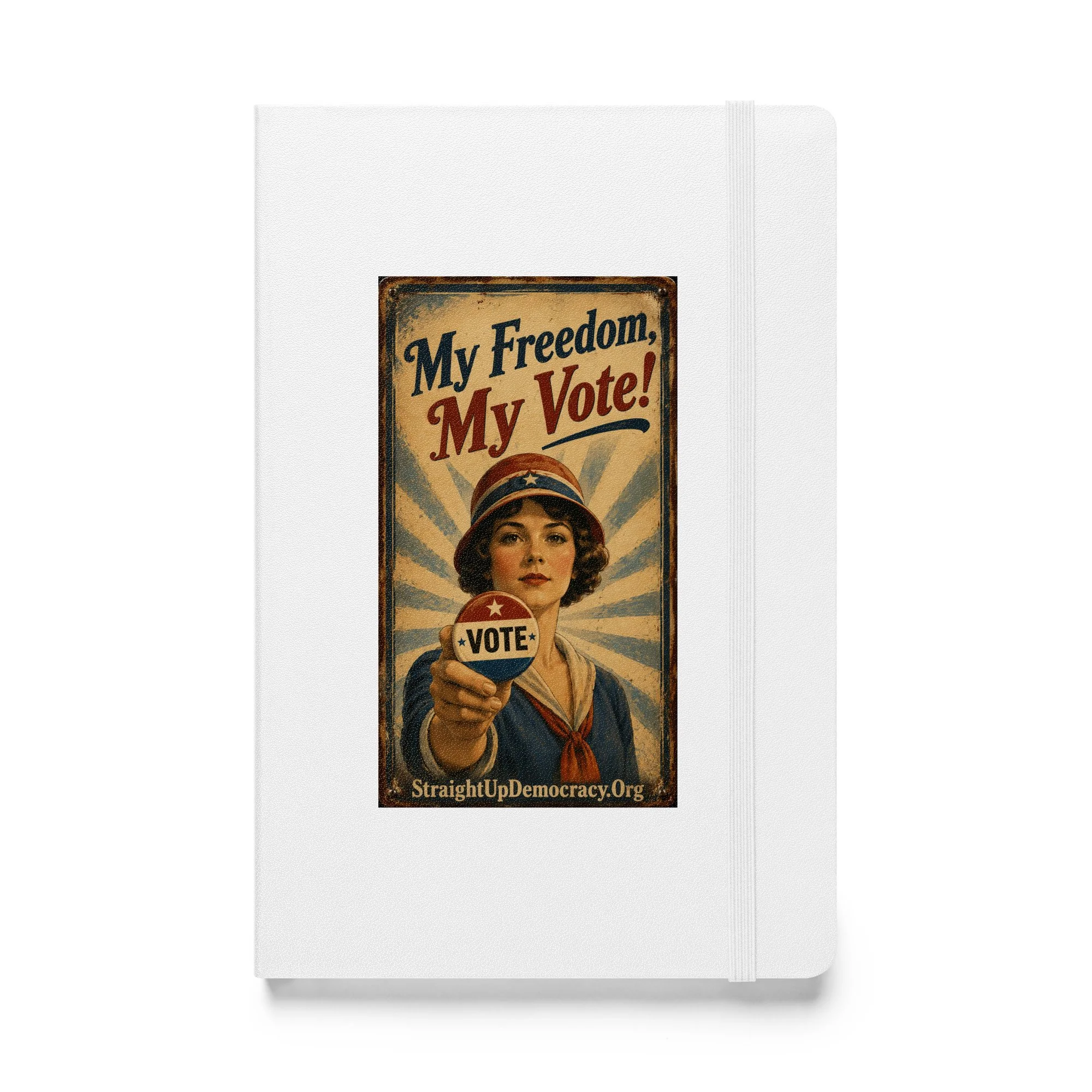
• Cover material: UltraHyde hardcover paper
• Size: 5.5" × 8.5" (13.97 cm × 21.59 cm)
• Weight: 10.9 oz (309 g)
• 80 pages of lined, cream-colored paper
• Matching elastic closure and ribbon marker
• Expandable inner pocket
Age restrictions: For adults
EU Warranty: 2 years
Other compliance information: Meets the lead and phthalates level requirements.
In compliance with the General Product Safety Regulation (GPSR), The Democracy, Straight-Up! Project and SINDEN VENTURES LIMITED ensure that all consumer products offered are safe and meet EU standards. For any product safety related inquiries or concerns, please contact our EU representative at gpsr@sindenventures.com. You can also write to us at 45 Gould Hill Rd.
Worcester, VT 05682 or Markou Evgenikou 11, Mesa Geitonia, 4002, Limassol, Cyprus.