Why Social Media is the Enemy of Democracy (Kidding! Not kidding…)
When you walk into a public bathroom and you see writing on the wall, what do you do? Maybe you read it. Sometimes it’s crude. Sometimes its thoughtful or funny. Whatever. If there is a piece of graffiti that says, “For a Good Time, Call Wanda!” and then gives you her (supposed) phone number, do you call it? Don’t you assume that only an idiot would do that?
Social media is like that. Yes, people with verified accounts will use it as a communication platform. Yes, even The Democracy, Straight-Up project will use it for that. But a lot of it is just bathroom wall graffiti that isn’t doing us any good. It is noise, not signal.
And, even when messages are legit, there is a structural problem with social media, which is worth talking about because it mirrors the problem with the legacy system in general. Now, in the case of media outlets, freedom of speech guarantees them the right to exist without censorship. Americans like that. We like that. But when it comes to how we legislate, we have the right to design the system we want according to the rules that make sense to us.
Here are the similarities between social media and the weaknesses of the legacy system. And how the Straight-Up System fixes things up.
The Structural Similarities between Social Media and the Legacy System
It’s funny how social media is decried as an unwelcome new development when it comes to self-government. But it is really just the legacy system on steroids.
Attention concentrates, not evenly—but exponentially
In social media and the legacy system, attention flows toward a few highly visible nodes.
On social media, a few posts go viral while most go unseen.
In the legacy political system, a few voices dominate while most are barely heard.
This isn’t an accident—it’s an intentional structural feature.
Preferential attachment creates “hubs”
The more attention something gets, the more attention it attracts.
The more followers you have, the easier it is to gain more.
The more power or visibility a political actor has, the more they accumulate.
In network terms, this is called preferential attachment, or the “rich get richer” effect.
A small number of nodes dominate the network
On social media:
influencers,
viral accounts,
major platforms
In politics:
party leadership,
major donors,
media-amplified figures
These become hubs—highly connected nodes that shape the flow of information.
Hubs distort the signal
When a few nodes dominate:
fringe ideas can be amplified
nuanced views get flattened
emotional or sensational content outcompetes thoughtful content
What rises is not necessarily what is true or useful, but what is attention-grabbing.
Noise overwhelms signal
When everyone can broadcast to everyone:
volume increases
clarity decreases
Important ideas compete with:
misinformation
outrage
jokes
manipulation
The result is not informed decision-making—it’s signal overload.
Louder voices crowd out quieter ones
In both systems:
assertive personalities dominate
subtlety disappears
organized groups outperform individuals
quieter or less connected people fade into the background
Not because they have nothing to say—but because the structure doesn’t support them.
No built-in mechanism for error correction
In social media:
false information spreads rapidly
correction spreads slowly (if at all)
In legacy politics:
misalignment between voters and outcomes persists
errors persist until elections
misinformation can linger indefinitely
There is no continuous, structured way to:
check claims
refine positions
correct mistakes
Influence is not accountable in real time
Influencers and political actors can:
shape opinion
drive narratives
But:
they are not directly accountable to those they influence
feedback is indirect, delayed, or diffuse
Scale breaks meaningful participation
Both systems operate at massive scale:
millions of users
hundreds of thousands of constituents
At that size:
individual voices lose impact
participation becomes symbolic rather than effective
Freedom exists—but structure is missing
Both systems are built on freedom:
freedom of speech
freedom to participate
But freedom alone does not organize:
attention
decision-making
collective action
Freedom creates voices. But disorganized freedom also silences them.
So what do we do about it?
We don’t ban social media.
We don’t silence voices.
We don’t try to control what people say or think.
That’s not only unrealistic—it’s not desirable.
In a free society, the noise is part of the deal.
The real question is this:
What happens after all that noise reaches us?
Right now, the answer is: not much.
It washes over us, shapes opinion unevenly, and then somehow gets translated—poorly—into political outcomes.
What’s missing isn’t freedom.
What’s missing is a way to process what freedom produces.
A place where:
ideas can be examined, not just reacted to
voices can be heard without being drowned out
disagreement can lead to clarity instead of chaos
signals can be separated from noise
In other words, what’s missing is structure—not control from above, but structure aligned with human limitations and human potential. Structure that emerges from the voters, based on their needs.
That’s what the Straight-Up system enables voters to do.
How the Straight-Up System Addresses these Structural Problems
Straight-Up does not silence the noise being generated from the media-sphere. It out-processes it. It empowers truth.
Where attention concentrates , Straight-Up redistributes it
In the Straight-Up system:
attention is anchored locally in Circles of 6–12
every participant has a guaranteed space to be heard
no one competes with millions for visibility
Attention is no longer a scarce global resource—it is a locally abundant one.
Where preferential attachment creates hubs, Straight-Up limits structural accumulation
In the Straight-Up System:
the number of people one delegate can be ‘attached to’ is capped
delegation is granted, not accumulated
delegation is revocable at any time
No one becomes powerful just because they are already powerful.
Influence must be continuously renewed by trust.
Where hubs dominate the network , Straight-Up prevents permanent dominance
Any concentration of influence is:
temporary
issue-specific
reversible
Even a highly-visible delegate:
can lose proxies instantly
can be left by their Circle
can be bypassed entirely
Power can concentrate—but it is much less ‘sticky.’
Where hubs distort the signal , Straight-Up preserves signal integrity
Signals are:
formed in small groups
checked through something called a Back & Forth
aggregated layer by layer
Each step:
filters noise
clarifies intent
preserves meaning
Instead of distortion through amplification, you get clarity through aggregation.
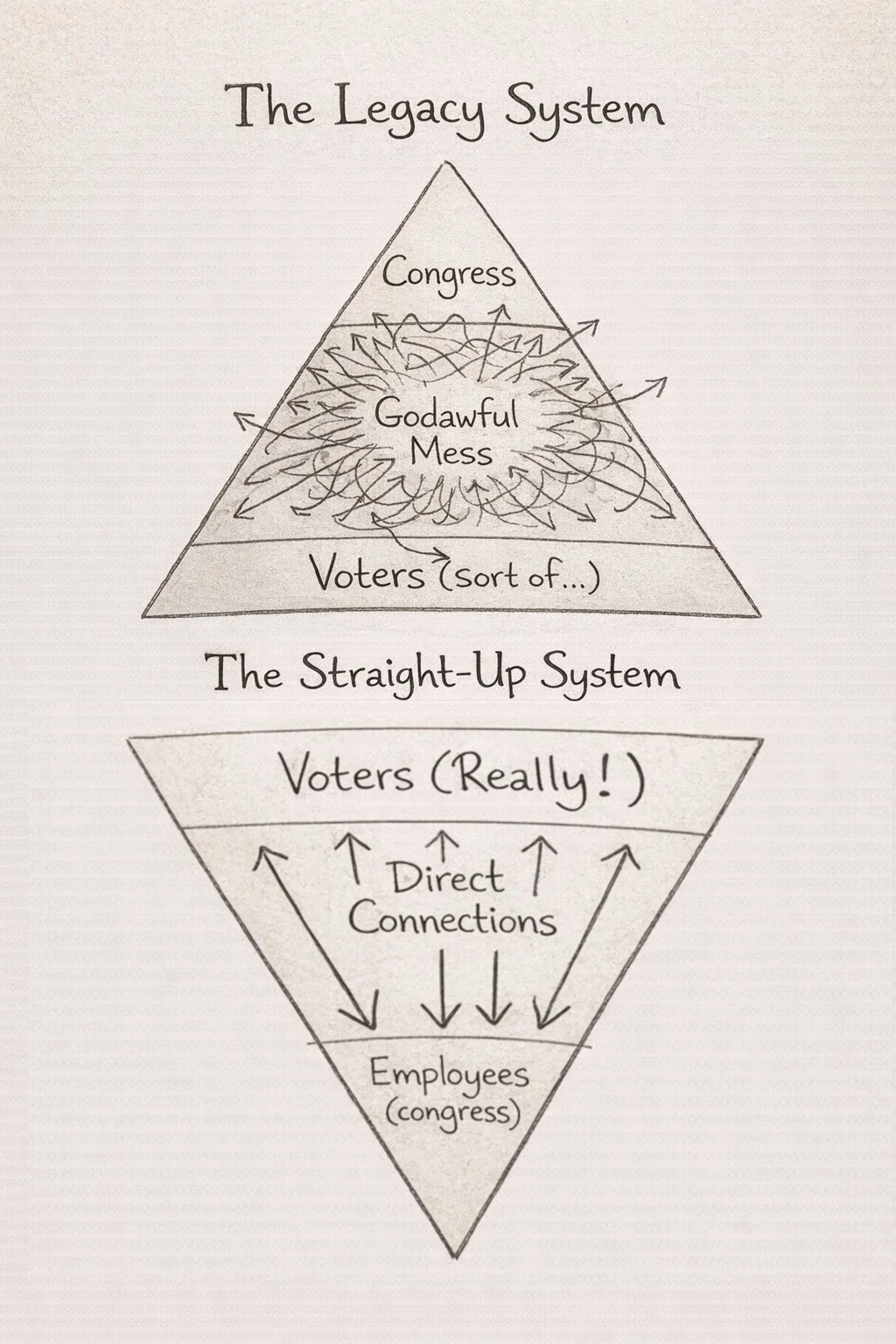
Where noise overwhelms signal , Straight-Up creates structured filtering
Input enters through:
Circles
Links
Delegation layers
This creates:
multiple stages of evaluation
repeated opportunities for correction
gradual entropy reduction
The system doesn’t silence noise—it out-processes it.
Where louder voices crowd out quieter ones , Straight-Up equalizes participation conditions
Human-scale group size ensures:
everyone can speak
no one can dominate by volume alone
And:
influence comes from trust, not loudness
The system is designed so that being heard does not require being loud.
Where there is no error correction , Straight-Up builds in continuous correction
Straight-Up has:
A Back & Forth (orders + reports)
proxy revocation
continuous feedback
This creates:
real-time correction
accountability at every layer
Mistakes don’t accumulate—they are caught and corrected along the way.
Where influence lacks accountability, Straight-Up makes influence answerable
Every delegate:
represents known people
operates under explicit instruction
can lose authority instantly
Influence is always tied to accountability and consent.
Where scale breaks participation, Straight-Up restores human scale
restores meaningful scale at the base:
Circles of 6–12
then scales through:
layered delegation
You don’t scale by enlarging groups. You scale by connecting small groups.
Where freedom exists but leads to confusion, Straight-Up provides freedom that leads to clarity
Structure aligned with:
human cognition
social interaction
trust formation
Freedom is preserved—but now it has a framework that makes it effective.