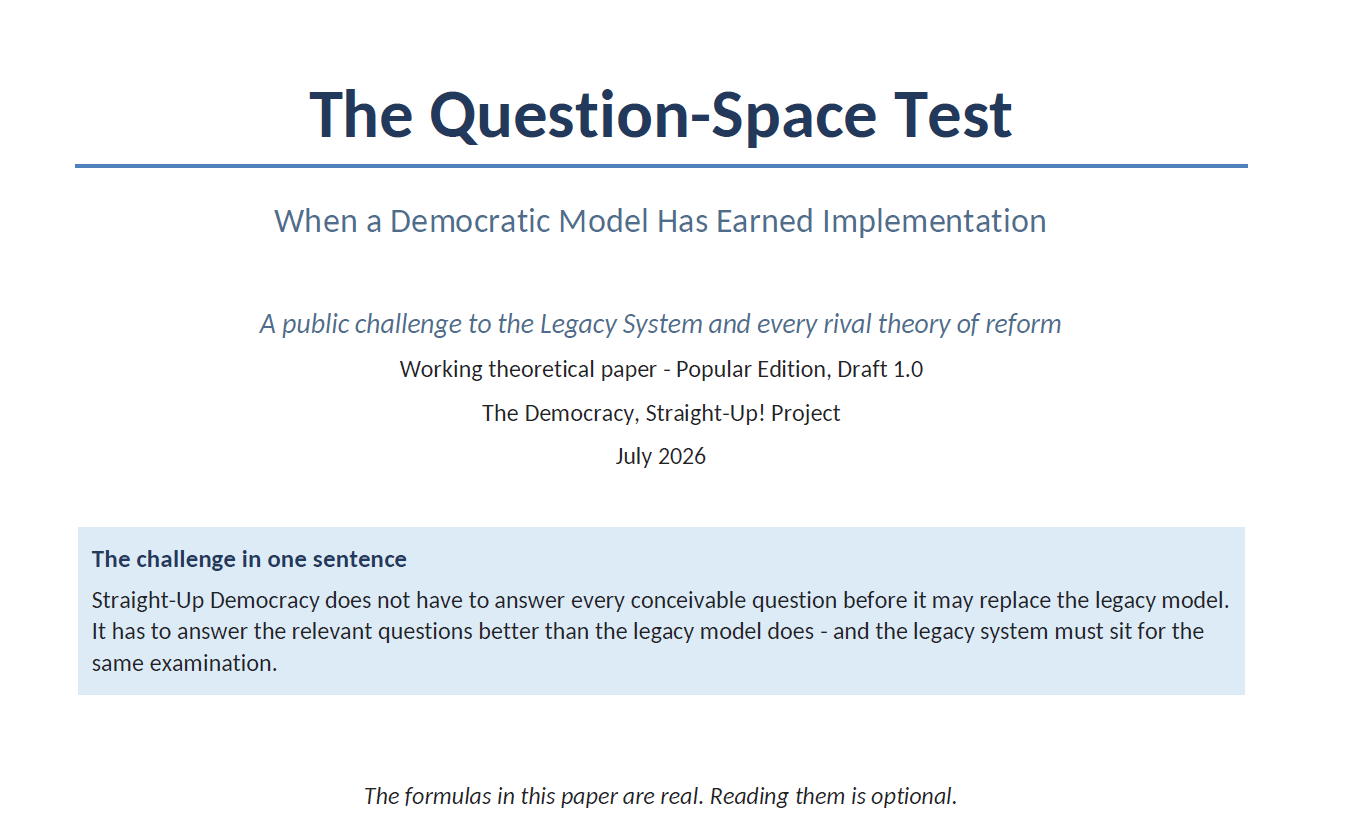
Seriously now…
Support for the Straight-Up Plan can be found across dozens of disciplines and goes very deep. As they are generated, documents will appear here and always link to their most recent versions. Please feel free to print out, download and distribute any of these documents as you see fit. Try to give everyone a heads up that the most up-to-date versions, however, can always be found here.
N.B.: These are drafts. Some of them may some day be legitimately publishable, but that will take a lot more work. In the meantime, load the docs into your favorite AI and ask the questions, “Is this a bunch of wishful thinking, or is this seriously something?”
For questions and further discussion—for the time-being at least—please email DemocracyStraightUp@gmail.com and/or schedule a time to talk with our Director, Dahlia Hart, through her Calendly account.
Read the Overview on the Website (If you skimmed it, read it again!)
Start here to get in the mood!
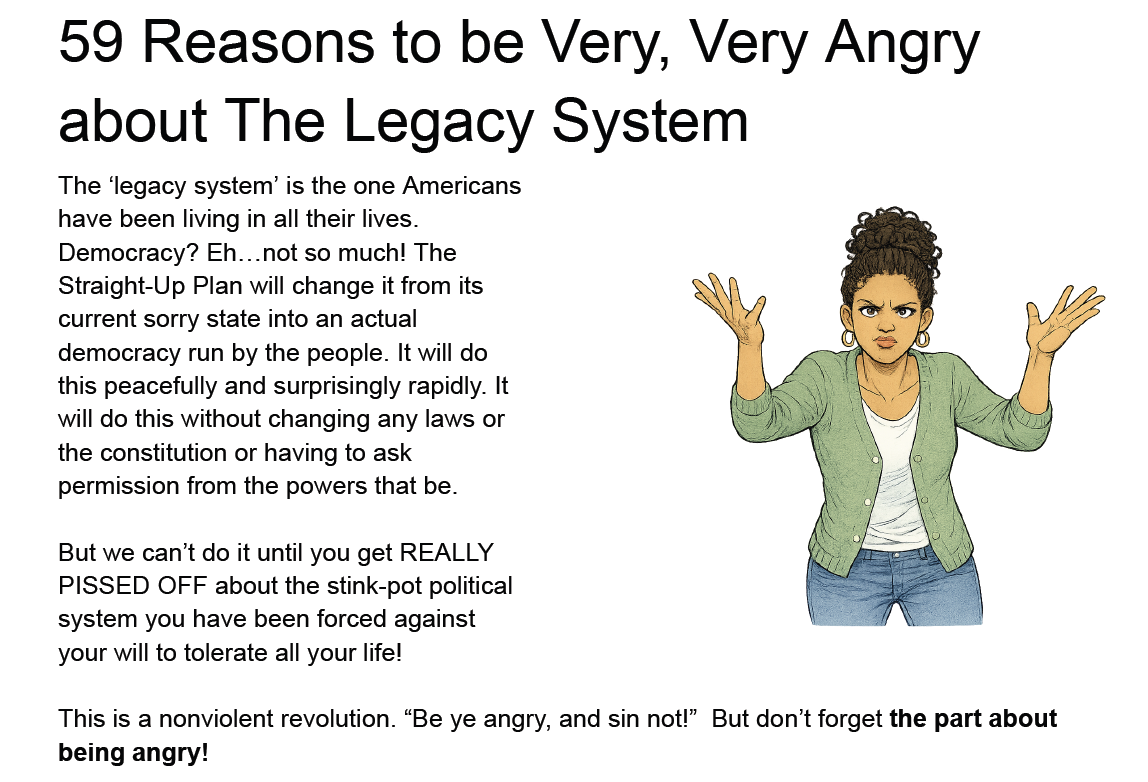
“Wait. Would people actually do this?” Just try and stop them!
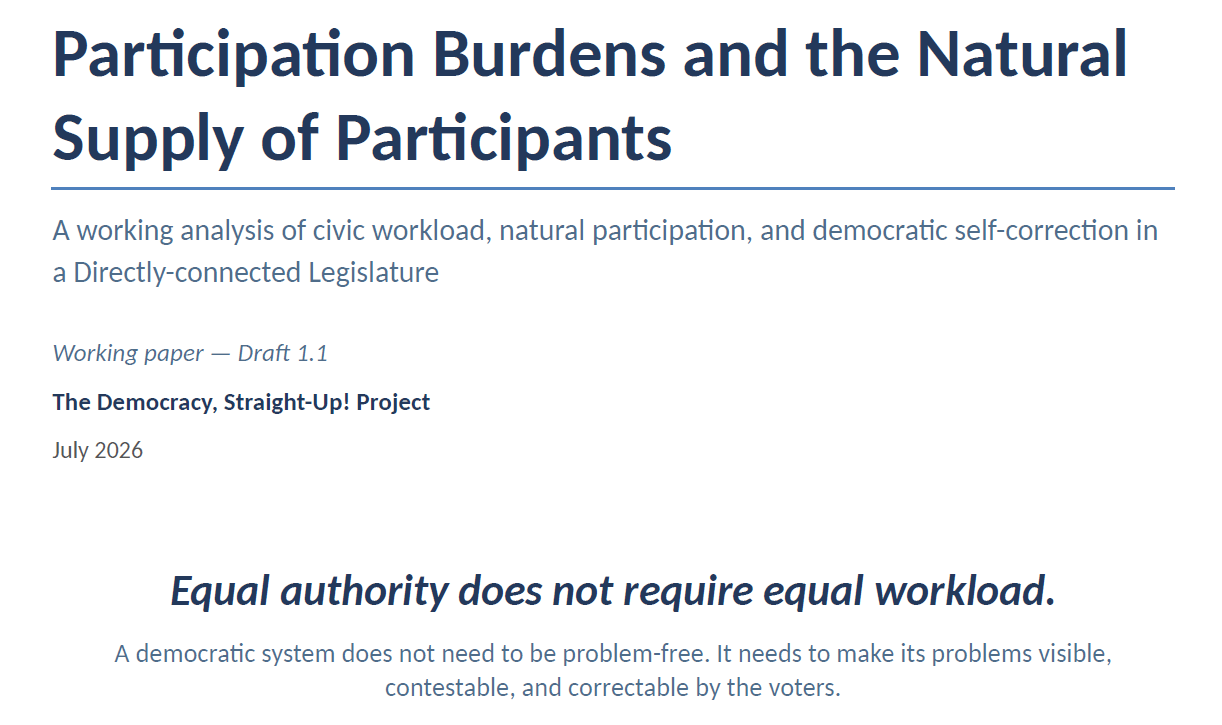
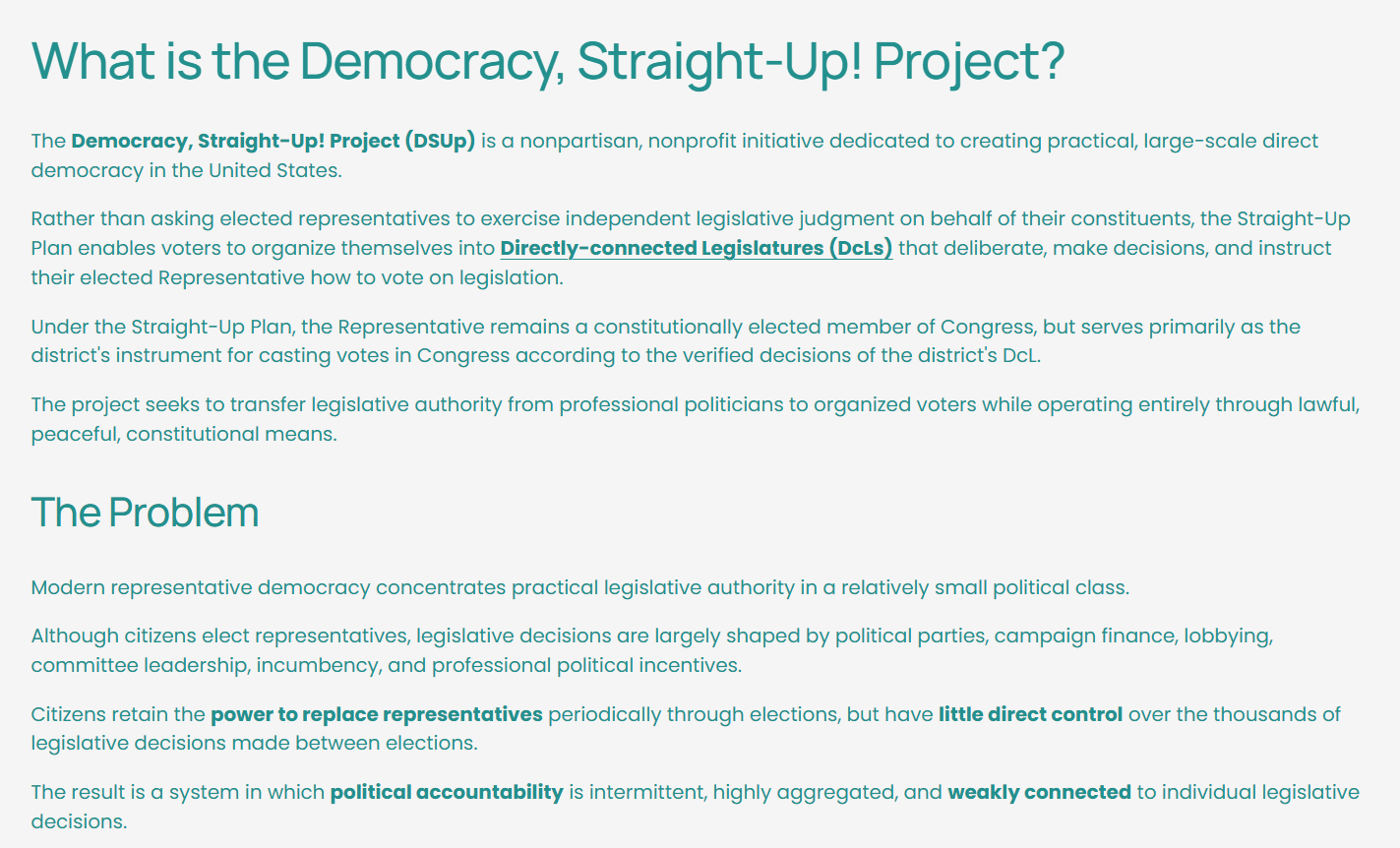
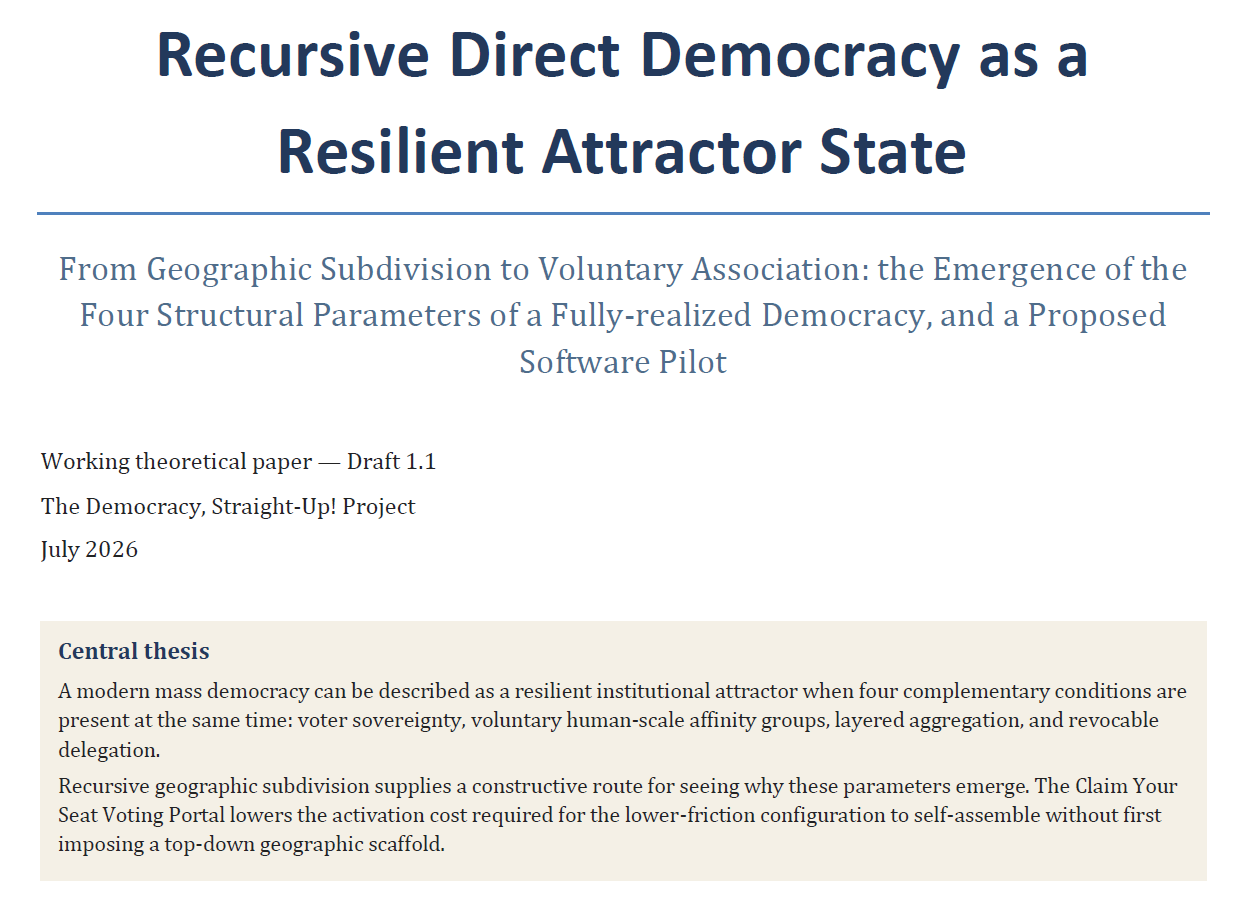
“A phase transition from oligarchy to a resilient, authentic democracy? Sounds like a load of gobbledygook!” Nope, just basic dynamical systems theory with a bits of entropy and a hearty helping of humanity!
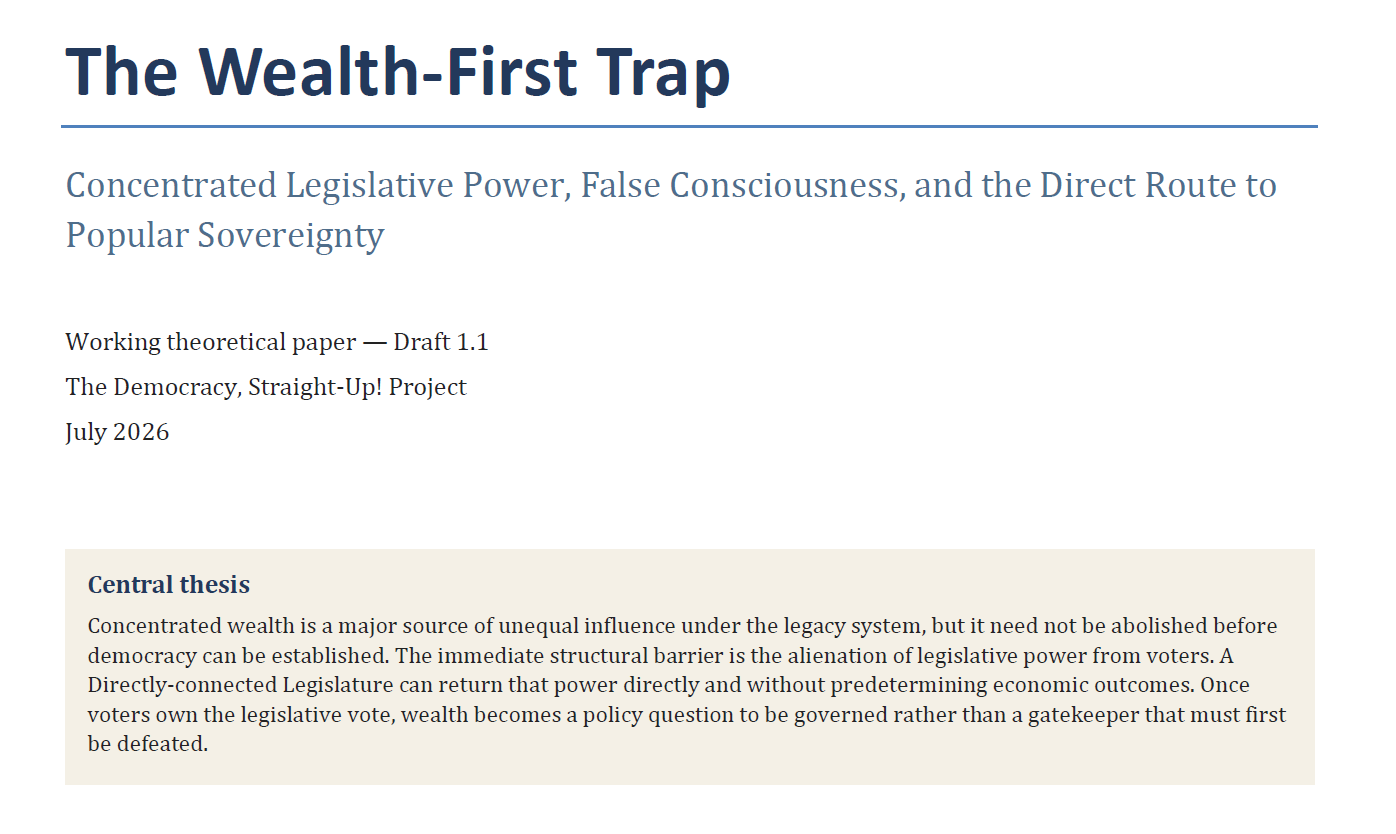
Kill the Rich? Not so much…
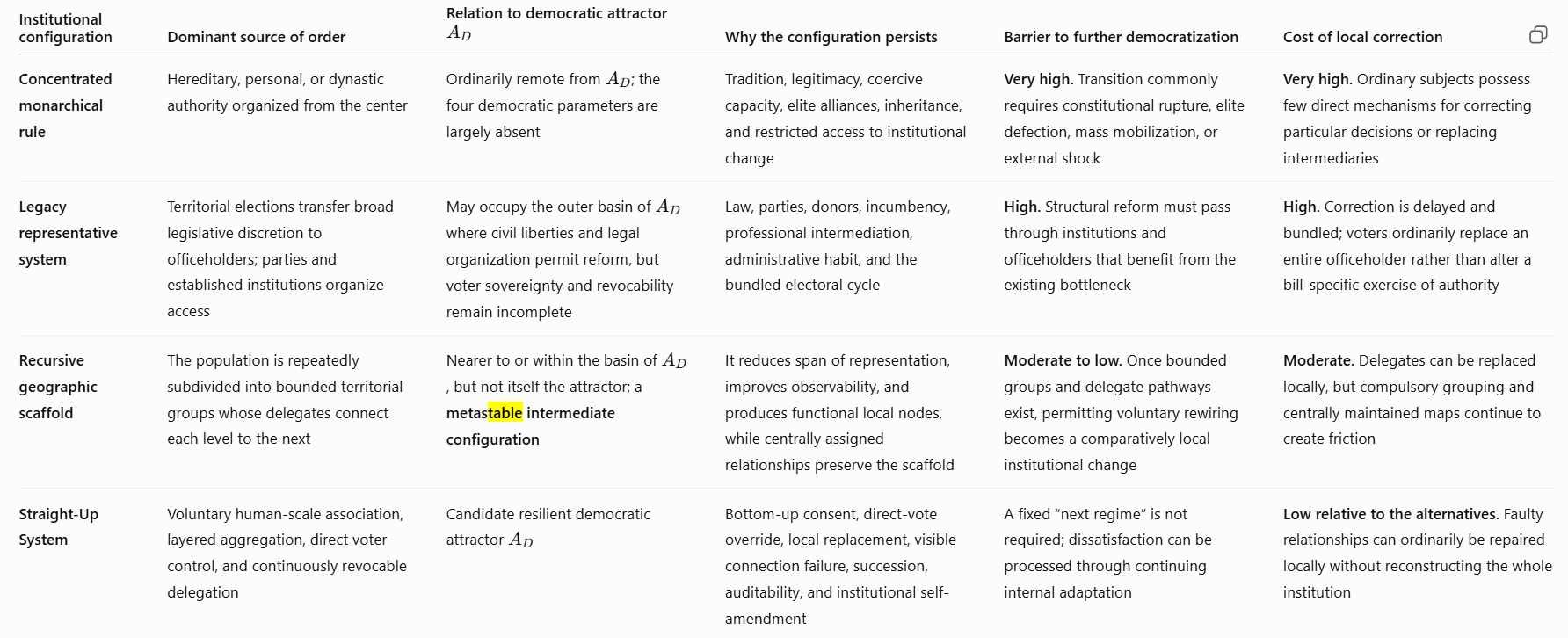
This table was too big for the Recursive Direct Democracy paper, and it is awesome! Check it out!
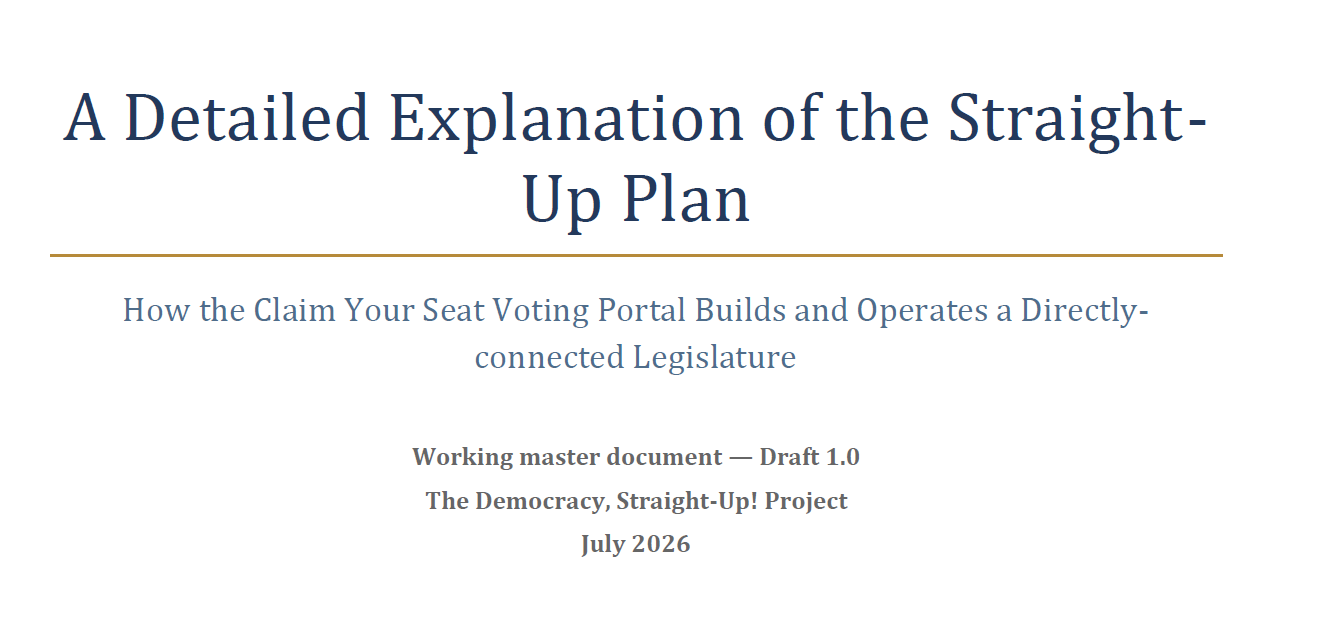
“How could millions of voters possibly all be in charge at the same time?” Here is your answer!
All Remaining Arguments
We love it when people ‘just get it’ and start to feel the power! Straight-Up Democracy is about breaking free from the shackles of the legacy system! But what about those who are apt to say, “Wait a minute! What about this…and that…and the other thing?”
We love you guys too! And we are working on getting you all the answers you could hope for! The All the Remaining Arguments… paper outlines 40 of the top ‘what about?’ questions and sketches out sixteen ‘companion papers’ that will effectively answer them.
The Mandate Problem
Rights Without Rulers
The Empirical Foundations of Straight-Up Democracy
The Launch Is the Pilot / Why Go Big?
Transient Engagement, Persistent Sovereignty
Participation Without Permanent Labor
The Change-the-Voters-First Trap
Affinity and Democratic Inclusion
Revocable Delegation and Distributed Oligarchy
Repair Under Voter Sovereignty
Governing Beyond the Final Vote
Democratic Expertise
Check out the All the Remaining Arguments paper and let us know which of these papers you’d like to see first. And, if you have a sensible question we didn’t anticipate, you win a million dollars! No, not really! But you’ll receive our warm appreciation!
Put Up or Shut Up!
That applies to us as much as any other actors in the democracy reform space.
We thought it would be useful (and fun!) to find a way to take statements like, “Well, I just think we’d be better off doing it this way…” and turning them into testable hypotheses.
Laying Down the Gauntlet
We challenge you to a contest!
The Where-do-we-go-from-here Challenge
When it comes to Straight Up and other democracy reform efforts, you may be tempted to think, “Isn’t there room for both?” But democratic reform has limited money, labor, leadership, public attention, and time. Every organization and reform tradition necessarily makes choices about where the next volunteer hour, donated dollar, public argument, and institutional investment should go. So there is a real opportunity cost associated with going down the wrong path.
And the assumption is that democracy reform efforts are all complementary paths headed in the same direction. While this is true of some efforts, it is definitely not true of all of them. One tactic may undermine another. For instance, efforts to prop up and improve the legacy system are anathema to the Straight-Upper. There are other examples. So it does matter whether those of us dreaming of a certain democratic future find a shared vision of, not just what it looks like, but how to get there.
The relevant question is:
What is the strongest case that democratic reformers should continue to give priority to your present theory of change rather than redirect substantial effort toward implementing the Straight-Up Plan?
A steelman answer should:
identify the principal bottleneck that prevents democratic government;
explain the causal mechanism by which the proposed strategy overcomes that bottleneck;
show why success does not depend upon first obtaining reforms from the institutions or powerholders responsible for the problem;
explain why transferring continuing legislative control to voters is unnecessary, premature, inferior, or unacceptably dangerous;
compare the proposal with Straight-Up under the same questions and standards;
identify the evidence or results that would justify abandoning or revising the present strategy.
The challenge is not to prove that the existing work is valuable. Many reforms are valuable. The challenge is to explain why that work should retain strategic priority when a practical route to transferring legislative power to voters has been placed on the table.