The Civic Harassment Industry
One of the ways the Big Disconnect manifests in our society is through what we like to call the ‘Civic Harassment Industry.’ This is a play on ‘Civic Engagement Industry.’
The civic engagement industry pretends to offer citizens a voice. But it always does this by first saying, “Because you’re too lazy to learn about the issues, sit down and study these materials. Because you are contentious and argumentative, learn to engage in active listening and to compromise.” And there are corollaries. Political campaigns blast at you to support a candidate, guilting you if you don’t, filling you with fear to motivate you, demonizing the political opposition to win you over to their side, only giving you the information that serves their interests. And forcing you to either ‘do your own research’ or give up. “If only you cared more about the issues, if only you weren’t so apolitical. Just give us $27.50! You can afford that!” But, of course, so many causes and campaigns want your money all the time. How are you going to decide where to put that money even if you had it?
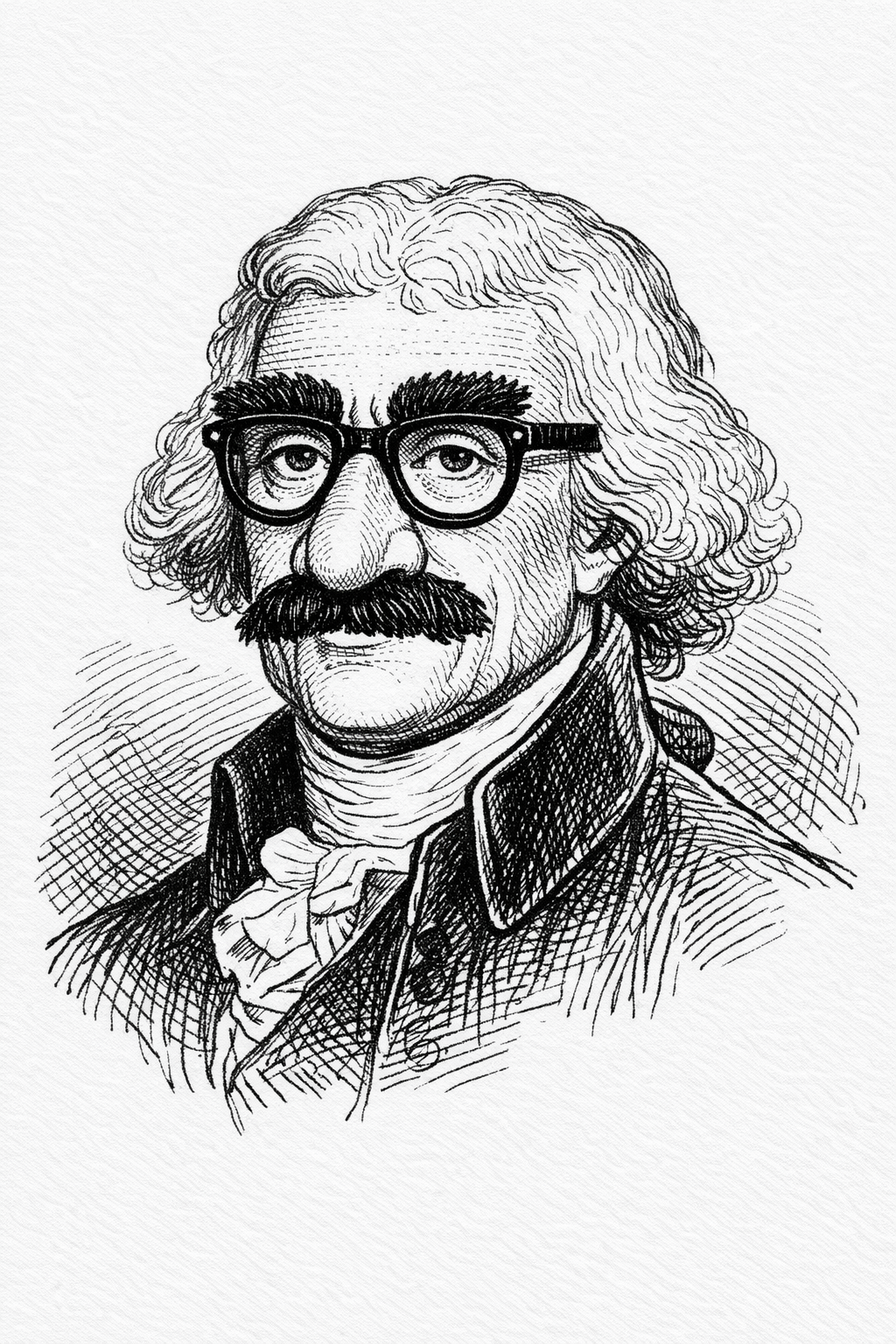
In essence, what they are saying is, “Why are you spending so much of your time enjoying the lifestyle that a system of personal liberty affords? Why aren’t you spending all of your time doing the boring, tedious work of protecting those liberties! How dare you take time to take care of yourself and your loved ones, and maybe even have a good time once in a while!”
The Hinky Notion of ‘Eternal Vigilance.’
Have you heard the quote, “Eternal vigilance is the price of liberty?” It’s an oft-repeated slogan, sprung from the mind of a national hero–a past president of the United States, no less–and leading author of that world-changing document, the Declaration of Independence–Thomas Jefferson.
None other than Kofi Annan, Nobel Peace Prize laureate, former Secretary-General of the United Nations has been known to repeat the quote to instill a solemn sense of duty, and urge strenuous acts of civic participation.
Except there is a small problem. There is no evidence that Thomas Jefferson ever said it! Yes, the Monticello institute, which tracks this sort of thing, says, “Eh, not so much.”
So, okay. Even if the big man himself didn’t say it, it’s still a proper sentiment, right? Certainly you wouldn’t want to encourage the citizens of a democracy to
The Totally Suss Origins of the Phrase
“Eternal vigilance is the price of liberty,’ and its variants, was often repeated in the 1800’s, typically in the context of protecting our democratic freedoms. Anna Berkes has written about it for Monticello.org:
Andrew Jackson said this in his farewell speech in 1837. James Buchanan said this in a speech on veto power in 1842. Frederick Douglass apparently said this enough to warrant discussion in this book on Frederick Douglass’ proverbial rhetoric
The quote remains popular today. Even if you don’t have it stored (possibly unexamined) somewhere in your head, it’s certain that many of the people around you do. Its sentiment shapes much of our political discourse.
But what, exactly, does it mean? Perhaps a look at the real history of the phrase will offer some insight. We’ll allow Anna Berkes to continue to help us out.
She traces its (most probable) origin to a speech by John Philpot Curran, given in Dublin in 1790. “The condition upon which God hath given liberty to man is eternal vigilance.” This means the actual author of the quote wasn’t even talking about democracy. He was talking about God. God, in his view, has given us freedom, which means the freedom to sin, and the price we pay for that ‘liberty’ is constant vigilance, i.e., being very, very careful not to sin.
Subsequently, the quote was repurposed by well-intentioned speakers and thinkers to apply to democracy. But in doing so, were they really helping? Or were they, inadvertently perhaps, making the task of reform within a democracy even harder to achieve.
It implies this: the only problem, or maybe just the main problem, with our democracy (at least when things get bumpy) is that not enough people are being sufficiently vigilant. And, notice it really does speak to the number of vigilant citizens. It is never used to invoke a vision of a small minority of citizens being judiciously put to good use.
And what is the most desirable number of vigilant citizens? Well, all of them, naturally! You can’t say that constant vigilance is the price of freedom–but only if you feel like it! No, the rule applies without exception. So, the solution to any given problem, perhaps all problems, has to be to get everyone to be vigilant! And, if democracy is stumbling, what’s the solution? More vigilance!
And here’s the kicker–if not enough people are being vigilant enough, who is to blame? Well, they are, the people themselves are to blame! If democracy is imperfect, it’s the people’s fault, those lazy fools so obviously lacking in vigilance. You get the government you deserve, sheeple!
So, in order to prevent our nation from being overtaken by tyranny, every single solitary citizen (at least the adults) must continuously monitor their surroundings, on high alert, detecting threats to ‘freedom,’ and, presumably, taking action to neutralize those threats.
Wait a minute. Isn’t that pretty must exactly what Joseph McCarthy was doing?
“The Pursuit of Happyness”
Now, let’s balance this state of affairs against another Jefferson quote, the one in the Declaration of Independence, about “...life, liberty, and the pursuit of happiness.” Fortunately, this time, we really can attribute the quote to Jefferson. Although the phrase was coined by John Locke years before, it was most likely Jefferson who put it into the constitution, and, in any case, it really does reflect the ‘civic architecture’ he and his colleagues intended for our democracy.
It’s important to stop and take note, before we go further, that the pursuit of happiness–in Jefferson’s mind, and in Locke’s mind–was not synonymous with the pursuit of hedonistic pleasure. It was something that we would probably think of, in modern parlance, as ‘individual fulfillment’. The point was, and still is, that this pursuit was thwarted by a class system where one's life chances were prescribed at birth. The great boon of democracy, to Jefferson and Locke, is that it affords us an escape from this kind of predestination, and allows each of us to pursue the path that suits us best. And the breakthrough idea that characterized The Enlightenment is that this would bring out the best in people and increase the common good.
So now we can take these two quotes together, the one about vigilance and the one about happiness, and see where that gets us.
Vigilant Happiness?
Let's characterize this process of fulfillment, of following one’s own path. It is well-understood to be somewhat complex and time-consuming. In fact, it might take everything you’ve got to navigate your way through life, and even then, there is no guarantee of any real success in terms of ‘happiness,’ however you define it. That’s sort of a bummer, but it’s still better–waaaay better–than having your future tightly circumscribed by an arbitrary system of social hierarchy, enforced by a system of laws designed by the powerful to enslave the powerless. We’re talking mostly about monarchy, the system we sloughed off when we took up arms against England and the Mad King.
So, here we are, undertaking one of the most vital functions of democracy– pursuing happiness, following our bliss and whatnot–but at the very same time we must be constantly vigilant regarding the business of self-government and how it affects our personal freedom, and the freedom of other individuals like us. As if each of us must endeavor to be some kind of tyranny-detecting robot, constantly shouting, “Danger, Will Robinson!”
Yeah, that doesn’t work, does it?
So how did we get it into our heads that everyone must constantly be vigilant in order for democracy to work–nay, for democracy to not fail?
However this notion grabbed hold of us, it is a decidedly bad one.
Consider the Alternate Hypothesis
But what if citizens are lazy and inattentive because of the form of their democratic institutions? It is not an inherent ‘flaw’ in the ‘character’ of the people that, gosh darn it, if they could only fix it, things would be peachy.
What if the reason is the institutions we live under were designed by a minority who wanted ‘the people’ to stay out of big decisions, so they made it so hard to participate, and kept them so busy and confused, that they literally couldn’t participate meaningfully even if they want to?
What is a ‘vigil’ Anyway?
Does it mean every individual being eternally vigilant. No! In fact, a vigil is typically thought of as one person, or a group of people, standing watch On behalf of a much larger group. It’s not important that you, personally, are constantly vigilant. It’s only important that someone is always standing vigil. And, it is important that if you want to join the vigil, and participate as an equal in that process, no one can stop you.
We only need to be ‘vigilant’ when a shadowy minority pulls the strings in ways that are impossible to keep track of.
The Straight-Up System
When you get rid of these dynamics embedded in the legacy system–which is something we absolutely have the ability to do–you have a low-maintenance system that simply articulates the will of the majority, looks for areas of improvement in how it functions, learns from its mistakes, and does a good job of preserving and enhancing our rights and freedoms without massive, hysterical acts of civic participation by people who have better things to do. Such as, I don’t know…pursue happiness! That is what DSUp Provides. And escape from the trap of ‘eternal vigilance.’ Relieve from the culture of constant ‘civic harassment.’ A place where the ‘marketplace of ideas’ is not operating in the middle of a war zone.